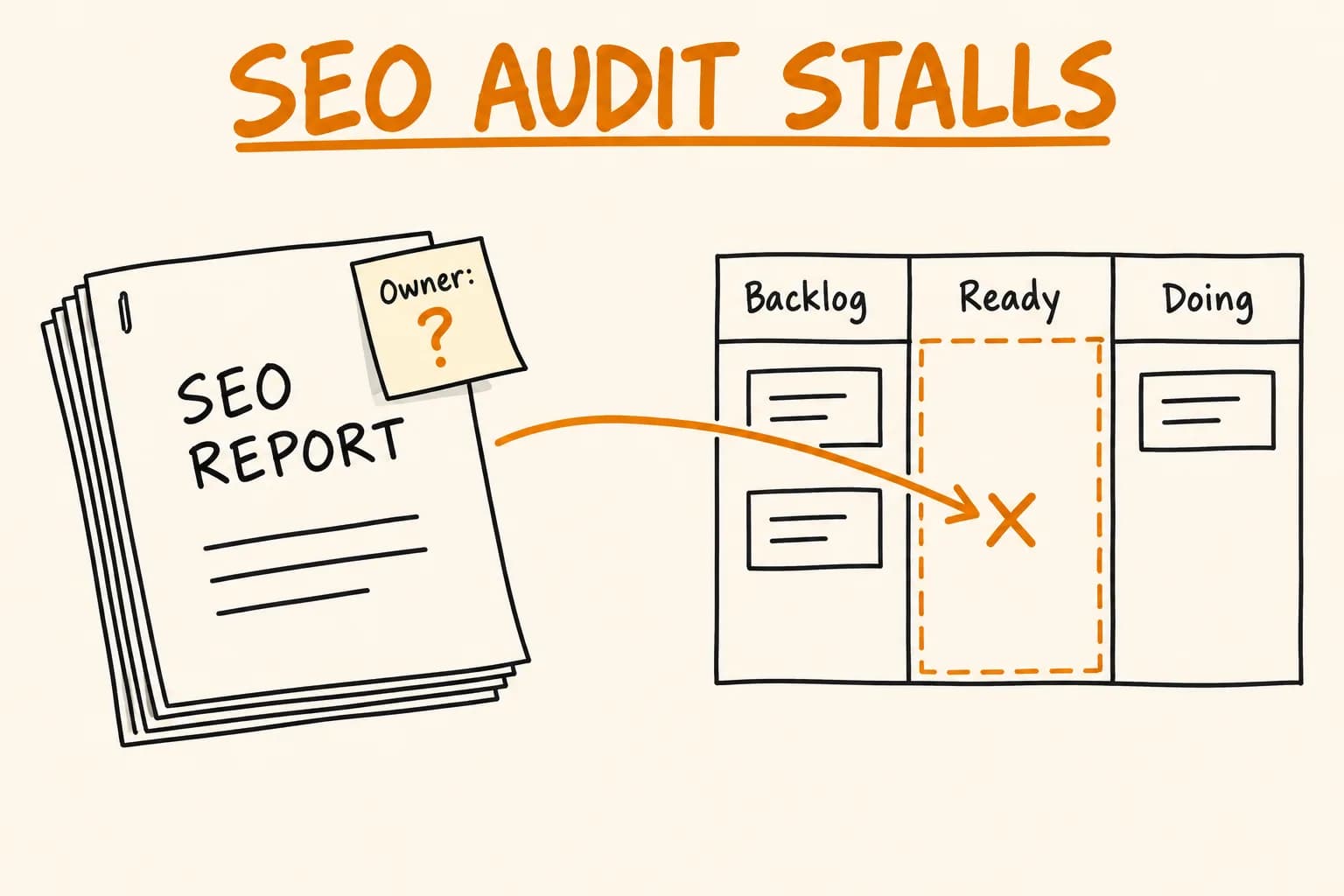
An SEO report stalls when nobody owns the fix list. The findings are written for an SEO specialist, the fixes land on a developer or a CMS admin, and that person already has a roadmap. The report is a document. The work is a ticket queue. Nothing connects the two unless someone is explicitly responsible for it.
So if you have a PDF in a folder and nothing has changed on the site, check ownership before you question the quality of the PDF. A report is advice. Unless you also bought someone to act on it, nothing moves. This post covers how that happens, what the delay costs in mechanical terms, and when buying the work makes more sense than buying another report.
Why Reports Stall
These reasons come from how the process works, not from a tally of reports I’ve seen. You can check each one against your own situation.
The reader is not the person who has to act. A report goes to the founder or the marketing lead. The fixes – redirects, canonical tags, structured data, robots rules, a template change – go to whoever can edit the code or the CMS. Those can be different people, even different companies. Take a made-up finding: ‘canonical tags point to the staging domain on 40 templates’ is clear to a developer and meaningless to the person who received the email.
There is no owner. ‘Marketing owns SEO’ and ‘engineering owns the site’ are both true, so a fix that needs both belongs to neither. Nobody is wrong. The task simply has no name next to it.
There is no order of work. A long list treats a blocked crawler and a missing alt text as items of the same weight. The person reading it cannot tell which five things matter, so they put it off until they have time to read all of it. That time does not arrive.
It competes with the roadmap, and it loses. A feature has a deadline, a stakeholder and a visible result. A fix to how search engines read your pages has none of these. In any week where something is on fire, the SEO list is the first thing that moves down.
The fix needs access the reader does not have. DNS, hosting, the Search Console property, the repository, the tag manager. If the report arrives without a plan for who gets access to what, the first step of every item is a request to somebody else.
None of this is about whether the audit was good. A correct report with no owner and no developer time produces the same outcome as a poor one.
What the Delay Costs
This section is reasoning, not measurement. I won’t put a euro figure on it: I don’t know your site, and a made-up number would only look like evidence. If you want a number, take your own inputs: how many pages are affected, what an organic visit is worth to you, how many months the list has been waiting. The mechanics below tell you where to look.
- Problems that block indexing keep blocking it. If a page cannot be crawled or is excluded from the index, it contributes nothing for as long as it stays that way. Fixing the problem does not make indexing instant either, so every month the problem stays is a month the clock has not started.
- New content goes onto a broken base. If you keep publishing pages while templates, canonicals or internal links are wrong, every new page inherits the problem. The cleanup later is larger than it would have been.
- An accidental block stays in place. On the audit side, the most common GEO finding I describe on the audit page is a default robots.txt, a WAF rule or a bot-protection toggle that stops AI crawlers from reading the site. Nobody chose it, so nobody notices it. As that page says, the fix is often a two-line change. Left alone, it keeps the assistants from reading the pages you want quoted.
- The report ages. The site changes, the competitors change, the search engines change. Six months later the findings are partly out of date, and the next report finds the same items again, plus new ones. You pay twice to learn the same thing.
- The slow metrics stay slow. On my service page the honest range for the first measurable movement is 2–4 months, longer in competitive markets. Every month the list sits, the start of that clock is pushed back by a month. That is the one part of the cost that is the same for everyone.
What a Report That Gets Implemented Looks Like
I built the format of my own audit report around the reasons above, so that a developer can read it and start the same day.
- Findings come in three tiers, in this order: critical first (things that block crawling, indexing or AI-crawler access), then quick wins (small changes with a clear effect), then strategic items (larger work that needs a decision).
- Every finding has three parts: the evidence (what I saw, in the rendered HTML, the sitemap, Search Console or the robots rules), the impact (what it affects and why), and the fix (what exactly to change). A finding without a fix is a complaint.
- It’s written for the person who will do the work, not the person who approves the invoice. If your developer can’t act on a line without asking me what it means, that line needs rewriting.
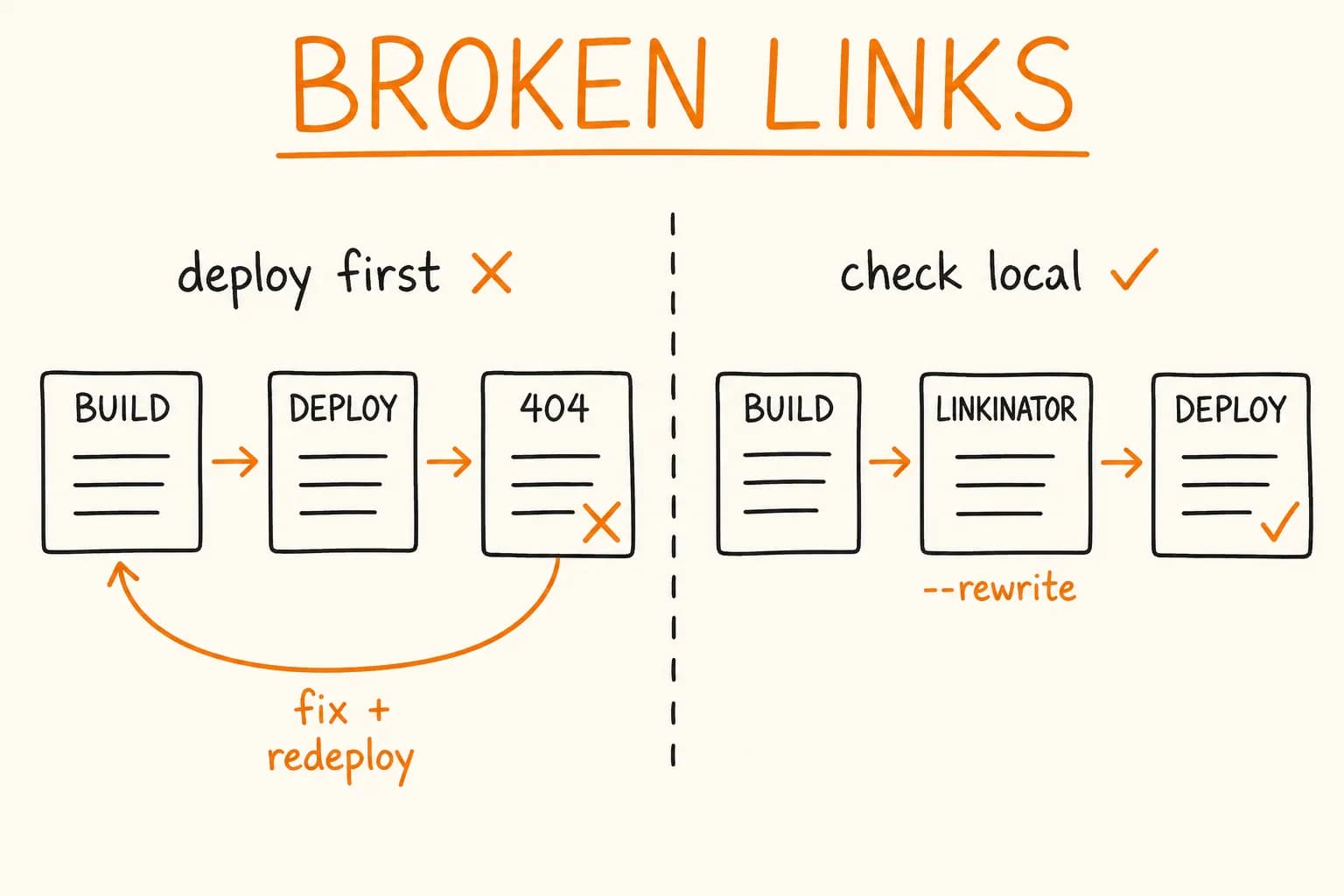
- It stays short where it can. Many technical fixes are small. Adding IndexNow, checking broken links in CI, shipping structured data by default or an llms.txt file are each a contained change, not a project. The report’s job is to say which ones your site needs and in what order.
A report written like this still needs an owner. It just removes the excuses that come from the document itself.
Report or Done-for-You Work
There are two options, and they suit different situations.
The report alone. The Technical SEO/GEO Audit is a fixed €800 written report, delivered within 5 working days of access (the work itself takes 3–5 days). It is complete on its own: you hand it to your developers and we are done. No call, no retainer, no follow-up sale. If you want a walk-through, a separate technical consultation is €200.
The work itself. SEO & AI Search Optimization is where I do the fixes: technical SEO, per-market keyword research, on-page work, content, schema and the AI-search layer. It is €1,200 a month for the first six months and €800 a month after that, with no minimum term. You can end it at the end of any month, and everything built stays yours. Each month you get a written summary of what was done, what changed and what is next. If you start with the audit and sign up within two weeks of receiving the report, the €800 is credited against the first month.
I do not guarantee positions. Nobody controls Google’s ranking, and a promise of position one means either a phrase nobody searches or a seller you should avoid. What I commit to is the work, and the technical layer, which is either correct or it is not.
Who Should Not Buy This
Monthly SEO from me is the wrong purchase if:
- You have developers with spare capacity and someone who owns the list. Buy the report only, or nothing. A retainer would duplicate what your team can already do.
- You need guaranteed rankings. I don’t sell that. If paid ads are what you are after, that is a separate service with separate terms.
- You want link building or PR. That is not part of this work.
- You want a content calendar to fill in yourself. I plan, write and publish the content. A calendar for your team is not what is on offer.
- You have several domains and expect one price. The scope is one site; more is quoted separately.
- The site sells nothing, or there is no search demand in your markets. Fix that first. Better SEO will not create demand that does not exist.
The Next Step
Look at the report you already have. If it has a named owner, a developer with time, and an order of work, go and use it. You don’t need me.
If it has none of those, you have two choices: assign them, or pay someone to act on it. Write to me with the report or the site and I will tell you which of the two you need. If the answer is ‘do it in-house’, that is a fine answer.