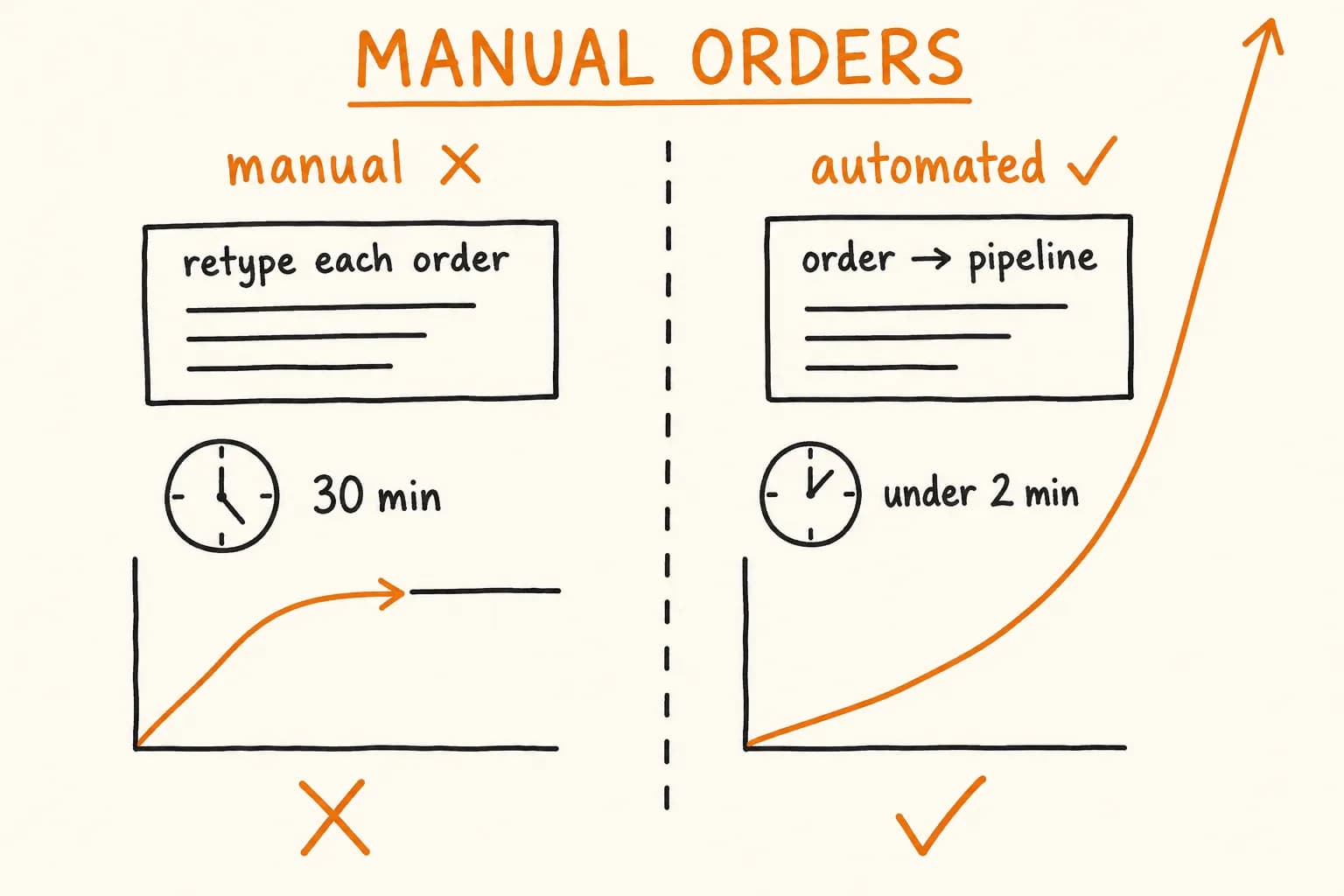
Ask a business owner what manual order processing costs them and you’ll usually get an answer in minutes. ‘It takes maybe half an hour per order.’ That number feels manageable, so it stays on the to-do list forever.
The minutes are the wrong number to look at.
The real cost of a manual process isn’t the time it takes today. It’s the ceiling it puts on tomorrow. A workflow that’s fine at a dozen orders a week quietly becomes the thing that stops you from taking a hundred. You don’t feel it as a cost. You feel it as ‘we can’t handle more right now’ – and you turn growth away without ever calling it that.
Where the Number Hides
Here’s a real example, without the marketing gloss.
A manufacturer decided to sell internationally. Before that decision, every order was processed by hand: confirm the payment, create the deal in the CRM, log the accounting entry, book the shipment, generate a PDF invoice, email it to the customer. Six steps, four different tools, repeated for every single order. Start to finish, about thirty minutes.
At a dozen orders a week, that’s a few hours. Annoying, but survivable. Nobody was going to build a system to save it.
Then the plan was to open thirty-two countries.
Suddenly that thirty-minute workflow wasn’t an annoyance – it was a wall. Thirty minutes per order doesn’t scale to a European launch. You either hire an operations team to absorb the volume, or the volume never arrives, because the moment orders climb past what one person can hand-process, something breaks: invoices go out late, a shipment gets booked to the wrong address, an accounting entry is missed, and the person doing it burns out.
The cost was never the thirty minutes. The cost was that the business couldn’t grow past the throughput of one tired human.
The Question That Actually Matters
‘How long does this take?’ is the wrong question. It leads you to shave minutes off a process that shouldn’t exist.
The better questions:
- Does this task repeat? A one-off doesn’t need automating. A thing you do fifty times a week does.
- Is it error-prone? Anything involving copying data between systems by hand will eventually be copied wrong. The question is only when, and how expensive the mistake is.
- Is it blocking growth? If handling twice the volume would require hiring someone whose whole job is this task, the task is a ceiling, not a chore.
If a process is repeated, error-prone, and standing between you and more business, that’s your candidate. If it’s occasional, judgment-heavy, and doesn’t scale with volume, leave it alone – automating it costs more than it saves.
That last part matters, so I’ll say it plainly: not everything should be automated. Which brings us to the honest part.
What Not to Automate
Most articles on this topic are written by people selling automation, so they tell you to automate everything. That’s how you end up with an expensive, brittle system that codifies a bad process and breaks the moment reality shifts.
Leave these alone, at least for now:
- Tasks that need human judgment. Deciding whether to accept a risky order, negotiating with an unhappy customer, approving an exception – these aren’t slow because they’re manual. They’re slow because they require a person to think. Automating judgment produces confident, fast mistakes.
- Processes you’re about to change anyway. If you’re not sure a workflow is right, don’t automate it. You’ll spend the budget encoding a process you abandon in three months.
- The rare stuff. Automating a task that happens twice a year is a hobby, not an investment. The math never works.
Automation earns its cost on the boring, repeated, high-volume, error-prone work. That’s where the ceiling actually is – and that’s the only place worth starting.
What ‘Done Right’ Actually Looks Like
Back to the manufacturer. The order workflow was the primary problem, so it was solved first – before the storefront features, before anything customer-facing was polished.
The result: the moment a customer’s payment clears, one process fires. The CRM gets the deal, the accounting system gets the entry, the shipment gets booked, the invoice PDF gets generated, and the email lands in the customer’s inbox – with no one touching any of it. Payment to invoice in the customer’s inbox: under two minutes, down from about thirty. Fully automated.
Notice what that number really means. The thirty-minute saving per order is nice. But the point isn’t the twenty-eight minutes. The point is that a European launch became operationally possible without hiring a fulfilment team. A new market went from ‘we need more people’ to ‘we need a config change.’ The ceiling moved.
A done-right automation has three properties worth insisting on:
- It handles the whole path, not half of it. Automating payment-to-CRM but still emailing invoices by hand just moves the bottleneck. The value comes from removing the human from the entire chain, not part of it.
- It fails loudly. When a shipment can’t be booked or an invoice can’t generate, someone gets told immediately. Silent automation that quietly drops orders is worse than doing it by hand, because you don’t find out until a customer complains.
- It’s yours, not the vendor’s. If adding a market or changing a step means a support ticket and a wait, you’ve traded a manual ceiling for a dependency ceiling. Different wall, same problem.
How to Know It’s Your Turn
You don’t need a consultant to spot the process that’s holding you back. You need to answer one question honestly: if orders doubled next month, what breaks first?
Whatever you just pictured – that’s the ceiling. It’s usually the thing everyone on the team has quietly accepted as ‘just how it works.’ Nobody’s counting the minutes because the minutes were never the problem.
If that workflow is repeated, error-prone, and standing between you and the growth you actually want, it’s worth automating. If it’s the occasional judgment call, it isn’t. The skill is telling those two apart before you spend a euro – and being honest when the answer is ‘leave it alone.’
If you can name the one process that would break if your volume doubled, you already know where to start. Let’s look at what it’s actually costing you.