Most articles about fractional CTO cost answer the wrong question. They quote a day rate, multiply it by two days a week, and present the annual figure like that settles it. It doesn’t. The number that matters isn’t what you pay – it’s what you’re buying instead, and whether you need it at all yet.
So let’s do the honest version. What does part-time senior technical leadership actually cost, what does it replace, and when does the math flip to a full-time hire – or to spending nothing at all for another six months?
(This piece assumes you already know what the role covers. If you’re still working that out, start here first – the numbers below make more sense once the scope is clear.)
The Three Prices You’re Choosing Between
When a non-technical founder has technical decisions piling up and no one qualified to make them, there are really three options on the table, and each has a different price.
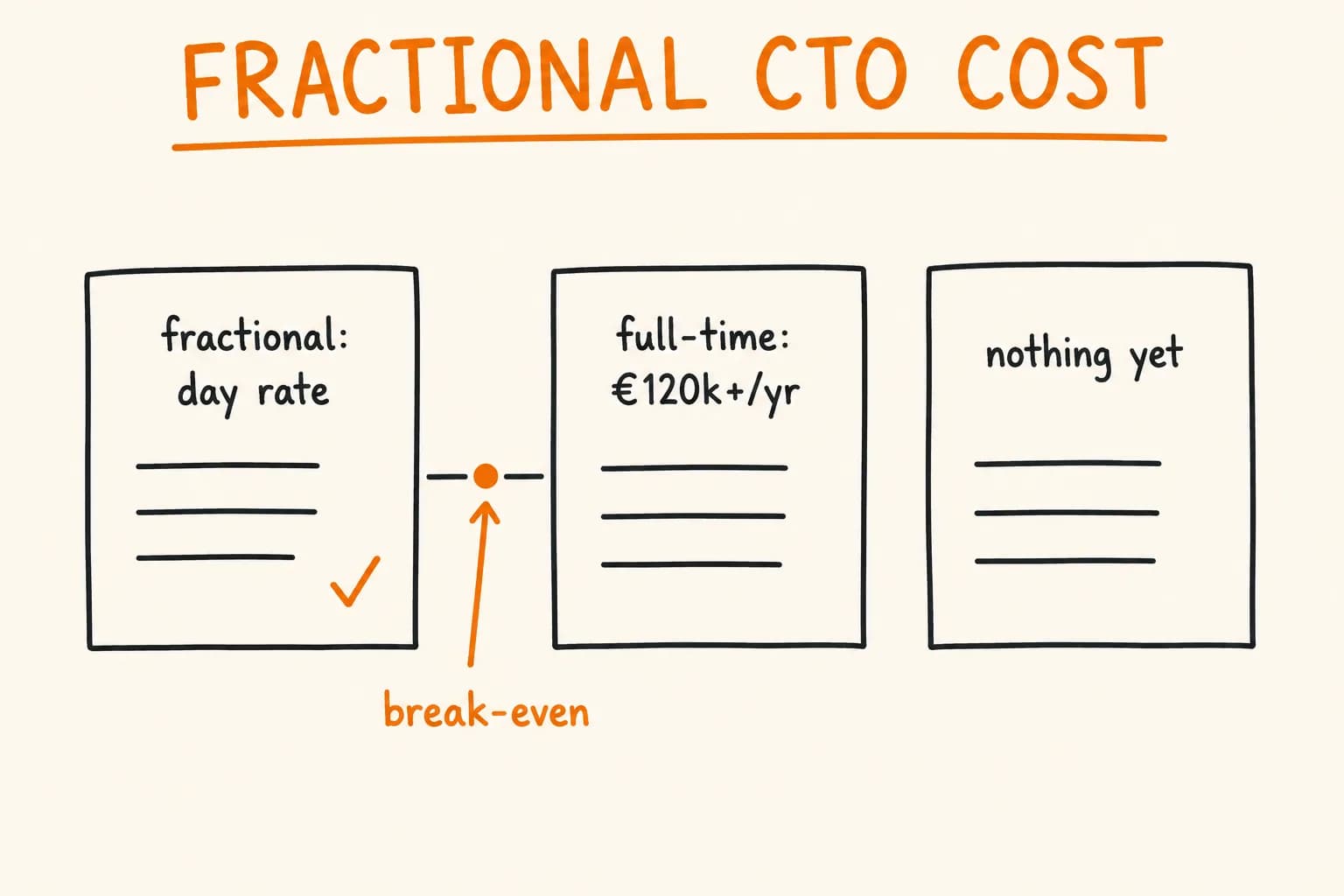
A full-time CTO. The salary depends heavily on country and stage – often somewhere in the €120,000–180,000 range in the EU – plus employer costs, plus equity in many cases, plus the six-month search to find one, plus the risk that the person you hire at that price turns out to be wrong for a company your size. The salary is the smallest part of that sentence. The search and the mis-hire risk are the expensive parts.
An agency. You pay a blended rate covering their salaries, overhead, sales team, and margin. The people who scoped your project are rarely the people who build it, and nobody is accountable to you for the architecture two years from now. Agencies are good at delivering defined work. They’re structurally bad at owning your company’s long-term technical direction, because your company isn’t their company.
A fractional CTO. Senior leadership, part-time – typically one to three days a week. You’re paying for judgment, not hours: the architecture calls, the hiring decisions, the vendor evaluations, the ‘don’t build that’ that saves you six weeks. The monthly cost lands well below a full-time salary because you’re buying a fraction of a person’s time, not a fraction of their seniority.
Notice the trick in that comparison. The fractional CTO isn’t cheaper because they’re less experienced. They’re cheaper because you’re only buying the part you actually need – the senior judgment – without the full-time overhead of a role your stage can’t yet keep busy.
Where the Break-Even Actually Sits
The break-even isn’t a spreadsheet line. It’s a question about how much genuine senior decision-making your company generates per week.
A company making one architecture-shaping decision a month does not need a full-time CTO. At that stage a full-timer spends most of the week inventing work to justify the seat – or worse, over-engineering, building for scale you don’t have, adding complexity that becomes someone’s problem later. You’d be paying a six-figure salary for a person busy 20% of the time on the things only they can do.
That same company still feels the pain when those monthly decisions get made badly or not at all. That’s the gap a fractional CTO fills. Picture a CEO with a small in-house dev team where nobody internal is senior enough to make the hard architectural calls, and a full-time CTO doesn’t make sense at that stage. Two days a week is enough to untangle a deployment process, sit in on hiring, and help the team push back on a sales feature request that would have cost six weeks. The value isn’t in the hours. It’s in the six weeks that don’t get wasted.
That’s the real math. If part-time senior judgment prevents one bad hire, kills one unnecessary rewrite, or stops one six-week detour, it has usually paid for a quarter of itself in a single decision. The cost of the engagement is small next to the cost of the mistakes it prevents – and mistakes are exactly what a company accumulates when technical decisions get made by guessing.
When You Do NOT Need One Yet
Here’s the part the day-rate articles skip, because it costs them a sale.
If you’re pre-product-market-fit with one strong technical founder, you don’t need a fractional CTO. You need to keep building and shipping. A technical founder who can make reasonable architecture calls is not improved by paying someone to second-guess them monthly. Spend the money on runway.
If you have no engineers and no product yet, you don’t need one either. What you need is someone to build the first version – a senior contractor, or a technical co-founder if you can attract one. Hiring a fractional CTO to oversee a team that doesn’t exist is paying for management of nothing. The leadership need becomes real around the moment you start hiring engineers, not before.
If your technical work is genuinely defined and stable – adding features to a system that works, maintaining integrations, routine development – a contractor does that better and for less. A fractional CTO’s rate is justified by decisions, not by keystrokes. Paying leadership rates for execution work is the most common way founders overspend on this.
The pattern: you need a fractional CTO when you have more senior decisions than senior people to make them – and not before.
When Full-Time Is Actually the Right Spend
And the mirror of that: sometimes the fractional model is the wrong economy, and a full-time hire is genuinely cheaper in the long run.
The clearest signal is volume. When technical decisions stop being monthly and become daily – when your team is large enough that direction, unblocking, and coordination need someone in the room every day – a fractional CTO embedded a day or two a week starts leaving value on the table. Someone part-time carries less context than a full-timer. Past a certain scale, the decisions made while they’re not in the room cost more than the salary you saved.
The honest framing: the fractional model is a bridge, not a destination. A common case is a founder who has just raised and needs to double the team fast, but for whom a full-time CTO is a six-month search they don’t have time for. A fractional arrangement covers the gap – sets up the hiring loop, makes the infrastructure call before it becomes a fire – and when a permanent hire lands, the handover takes a week because everything was documented. That’s the model working as intended: it makes itself unnecessary.
If your company already generates enough senior technical work to keep a full-timer genuinely busy, and you can afford the salary and the search, hire the full-timer. The fractional CTO’s honest job at that point is to help you hire them and hand over cleanly – not to stretch the engagement indefinitely.
The One-Line Test
Strip away the rates and the comparison comes down to a single question: how many decisions that only a senior technical person can make does your company face this month – and does anyone qualified currently make them?
If the answer is ‘several, and no one’ – that’s the fractional CTO case, and the cost will look small against the first bad decision it prevents. If it’s ‘constant, and we need someone here every day’ – that’s the full-time case, and part-time is a false economy. If it’s ‘barely any, and our founder handles them fine’ – you don’t need either yet, and anyone telling you otherwise is selling you a title.
The cost of a fractional CTO is real, but it’s rarely the number that decides this. The number that decides it is what a wrong technical call costs you – and at most stages, that number is a lot bigger than a few days a week of senior judgment.
If you’re trying to work out whether your situation calls for part-time leadership, a full-time hire, or nothing yet, let’s talk it through – I’d rather tell you honestly which one the numbers point to than sell you the one that pays me.