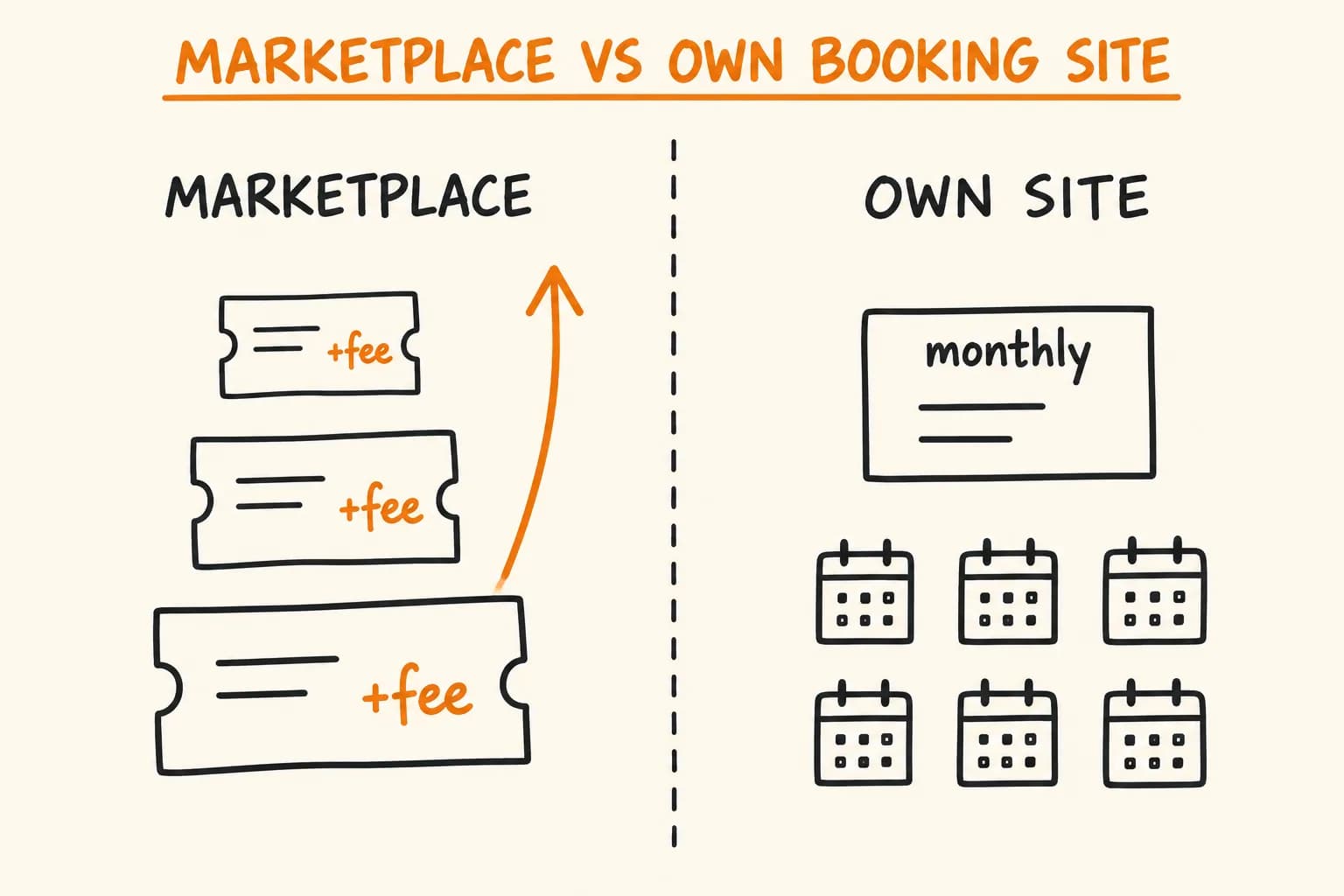
A salon pays €300 in marketplace fees and finds a booking website that costs €30 a month. Saving €270 looks obvious. It may also be the wrong calculation.
Some of that €300 may be paying for new clients the salon would not otherwise have reached. A booking page can accept an appointment; it does not automatically replace the channel that brought the person there. The useful comparison separates the cost of finding clients from the cost of taking their bookings.
I built KRI, a subscription booking product for beauty businesses, so this is a decision my own product sits inside. There are businesses for which it is a good fit, and businesses for which marketplace discovery is worth more than the fees they could avoid.
Start With the Fee You Actually Pay
Marketplace pricing is not one model. A provider might charge for a newly acquired client, every booking, payment processing, a software subscription, or some combination. Fresha, for example, describes its marketplace acquisition fee as a one-time commission on a new client who discovers the business there. It is not a commission on every returning visit. Check the terms for your country and account rather than assuming the same model everywhere. Fresha pricing.
Take a recent statement and separate these costs:
- Acquisition: fees for clients the marketplace brought to you.
- Repeat booking: any actual commission on returning clients; this may be zero.
- Software: the subscription and staff or location charges.
- Payments and messaging: processing fees, SMS and paid extras.
Then mark which costs would disappear if the booking moved to your own page. Card processing does not become free because a booking commission disappears. A discovery fee may remain if the marketplace originally supplied the client and its attribution rules still apply.
A Worked Example: €300 Does Not Mean €270 of Savings
These are illustrative numbers, not KRI prices or a customer result. Suppose a salon pays €200 for new-client acquisition and €100 in avoidable repeat-booking commissions each month. A separate booking subscription would cost €30, with another €10 in incremental messaging costs. Processing costs are assumed unchanged and excluded from both sides.
| Monthly cost | Current setup | Hybrid setup |
|---|---|---|
| Marketplace acquisition retained | €200 | €200 |
| Repeat-booking commission | €100 | €0 |
| Separate booking subscription | €0 | €30 |
| Additional messaging | €0 | €10 |
| Total | €300 | €240 |
The possible saving is €60, not €270. If setup and migration take €180 worth of time, the simple payback is three months, assuming the booking volume and service level stay the same.
Now change one fact: repeat bookings were already commission-free. The hybrid setup adds €40 per month without removing that €100, because the €100 never existed. You may still value the independent page, but fee savings no longer make the case.
Leaving the marketplace entirely is a different calculation. Estimate the cost of replacing the clients it brings and the contribution lost from appointments you cannot replace. Compare that contribution after service costs, not just gross sales. A lower software bill can coexist with a less profitable salon.
The Worksheet for Your Business
Use your own statement to answer five questions:
- Which fees would actually stop if existing clients booked directly?
- What would the new subscription, messages, payments and setup cost?
- Which discovery fees or existing subscriptions would you keep?
- How many bookings might you lose, and how would you replace them?
- What operational work would the change add or remove?
A useful first estimate is avoidable fees minus added operating costs, followed by a separate check of acquisition and lost contribution. Keep the time period and included features consistent. Review the result after a few months; do not treat an assumed shift in client behaviour as a measured saving.
Returning clients may prefer your own page, but familiarity does not prove they will move. Some value a marketplace account, saved details or its app. A small trial can tell you more than assuming every repeat client would have called you directly.
What an Independent Page Changes
A dedicated page gives your services and available appointments the focus. A marketplace helps visitors compare providers and can introduce you to people who were not searching for your name. Those are different jobs, and many salons benefit from both.
Ownership needs a closer look than the word “own” suggests. With a hosted booking product, you still rent the software. Before switching, check whether you can export clients and visit history, use a domain you control, retain useful URLs, and communicate with clients under the applicable consent rules. Ask what happens to the page and data when the subscription ends. Those are contractual and operational questions as much as product features.
An independent page does not automatically mean an independent domain. KRI currently gives the salon a personal address under kri.rocks. That is useful branding space, but it is still an address on the provider’s domain.
When to Keep the Marketplace
Keep paying for discovery when it brings appointments with enough contribution to justify the fee. This is especially relevant to a new business without a client base, a location serving visitors, or a service customers often search for at short notice.
A hybrid can work: retain marketplace discovery and offer a direct route to clients who already seek you out, where the platform’s terms and attribution rules permit it. Check how the two calendars stay in sync before adding a second booking surface. A saving that introduces conflicting availability can become an expensive support problem.
KRI fits the direct-booking side: one subscription based on the number of specialists taking bookings, with no booking commission or setup fee. Compare its features and total costs with the setup you actually need; a busy and quiet month cost the same only when the billable team size and other relevant conditions are unchanged.
When a Custom Website Is Worth Considering
Start with an existing booking product if it covers the workflow. A CRM connection does not by itself justify a custom build: check the product’s integrations and API first.
Custom work becomes relevant when an important requirement remains unmet, such as a particular membership flow, cross-location process or integration the available tools cannot support reliably. Sometimes the answer is a small integration rather than a replacement website. The broader build-versus-buy decision follows the same logic.
Choose the booking route by the work and demand it handles. Lower commission is valuable when the saving survives that comparison.