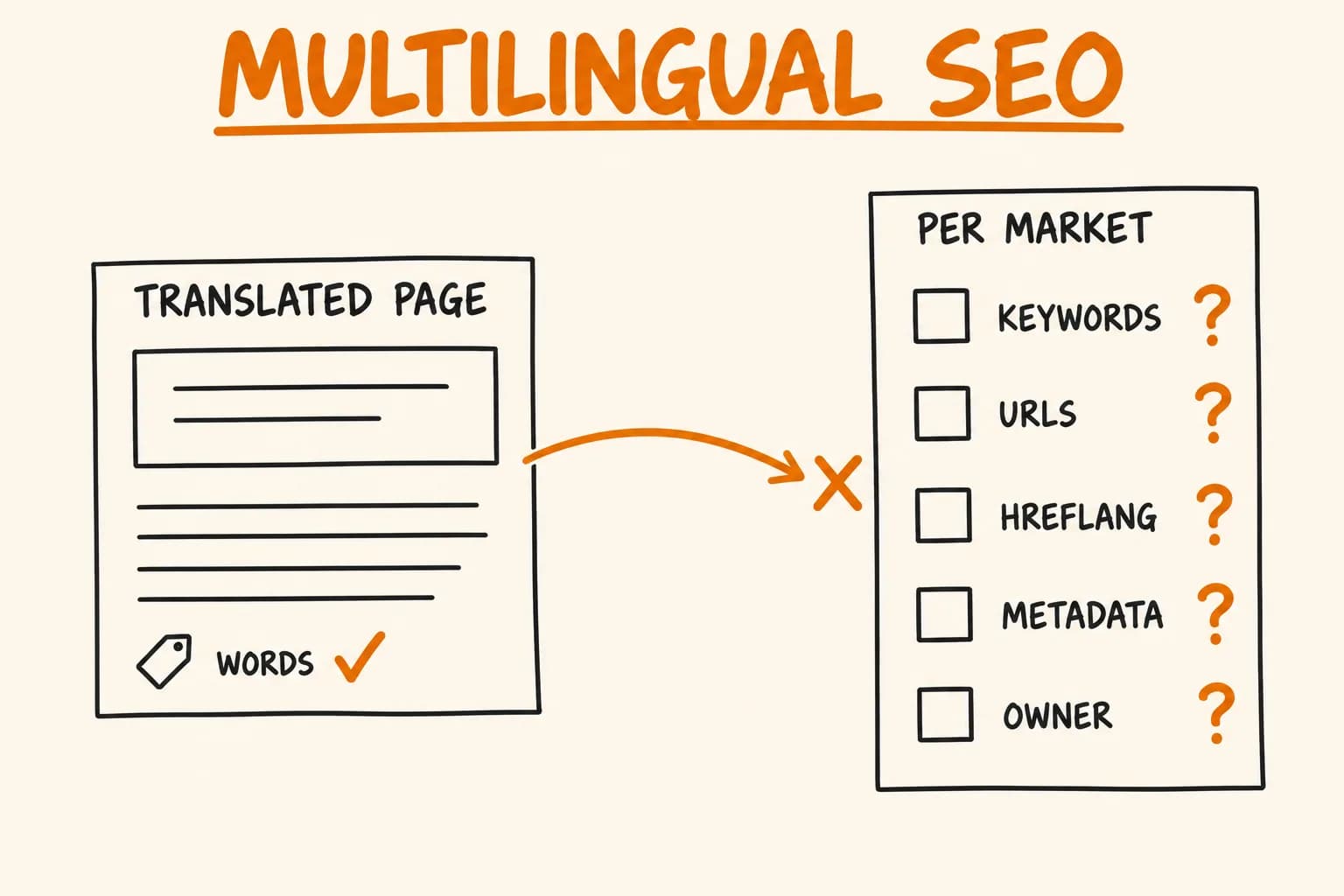
A translated site is not a multilingual SEO setup. Each market you sell in needs its own keyword research, its own URLs, hreflang annotations that stay correct as pages change, metadata written for that market, and a named person who keeps all of it current. Translation covers the words on the page. It covers none of the other five.
One definition before the rest. When I say local SEO services here, I mean search work done per market: each country and language you sell in. I do not mean a Google Business Profile listing for a shop in one city. That is a different job, and I come back to it below.
Why an English Playbook Fails When You Translate It
Keywords are not translatable. An English page is built around the phrase buyers type in English. Translate that phrase word for word and you get a phrase the target market may never use: a different term for the same product, a different level of formality, a different thing entirely.
Demand differs too. Search demand in Finland, Germany and Spain is not the same list translated three times. A product that has ten ways to be searched for in one country may have two in another, and a competitor you never heard of may own the results there.
So the English playbook breaks at its first step. If the keyword research was done once, in English, and every other language inherits it by translation, the other languages are optimized for queries nobody in those markets types.
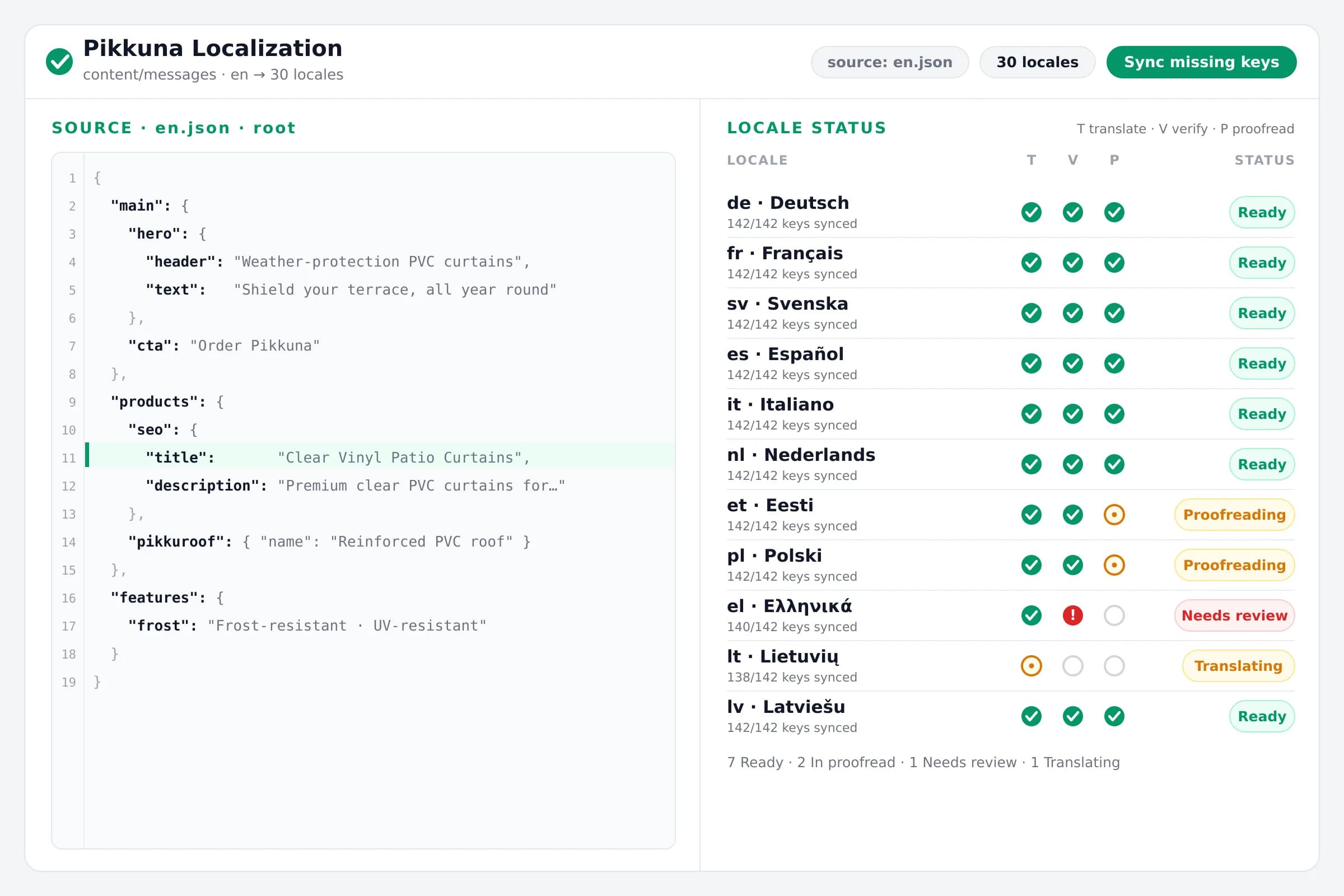
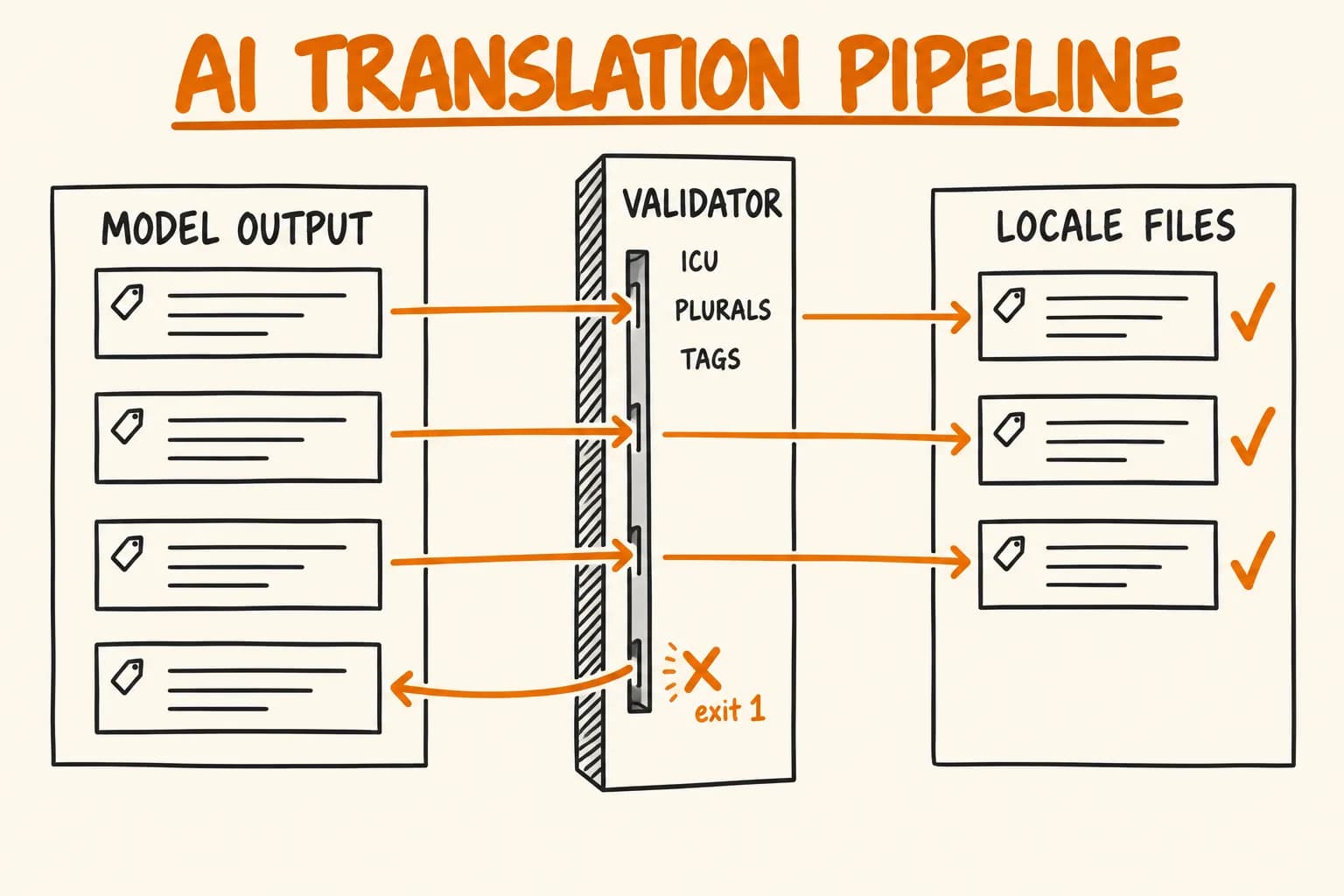
I ran into this directly at Pikkuna, a Finnish manufacturer, where I was Head of Development from 2024 to 2026. The localization pipeline there did not translate the English page and hope. The translation step took a per-market keyword spec as input, and tests enforced title length limits. The mechanism is described on the localization pipeline page. I am describing the process here, not a ranking result, because I have no search data from that project to show you.
Keyword Research Per Market, Not Translated Keywords
In practice this means three steps for every market you want to be found in:
- Find what people in that country actually search for, in their language.
- Map each term to the intent behind it: someone comparing, someone ready to buy, someone looking for information.
- Map that to a real page on your site, or to a page that has to be written.
The decision that belongs to you, not to the person doing the research, is how far to go in each market. There are roughly three levels:
- Full build. Category pages, product or service pages, blog content, all in the local language, researched for that market.
- Thin presence. The core pages only: what you sell, who it is for, how to buy. Enough to exist and to be correct.
- No translation. Some pages are not worth translating. A news post about a local event, a page about a regulation that applies in one country, a long guide whose audience is in one market. Translating them adds pages to maintain and no reader.
Choosing a level per market is a budget decision. A market with real demand and a working delivery or support setup earns a full build. A market where you have one customer a year earns a thin presence at most. A good plan says which is which before any translation starts.
URLs and hreflang Are Hygiene, Not a One-Time Task
Two technical things change when a site has more than one language, and both are easy to get quietly wrong.
URL structure. You choose between language folders on one domain (/fi/, /de/), a separate domain per country, or subdomains. For most businesses one domain with folders is the simplest to run, but that depends on your situation, and I will say which I would pick after looking at yours. What matters for you: choose early. Changing structure later means every URL moves, and that is expensive and visible.
hreflang. This is the annotation that tells a search engine which version of a page is meant for which language or region. Google treats it as a hint, not a command, and it does not boost rankings by itself. What it does is help the right version show up for the right reader instead of the wrong one. The rules are mechanical:
<link rel="alternate" hreflang="fi" href="https://example.com/fi/" />
<link rel="alternate" hreflang="de" href="https://example.com/de/" />
<link rel="alternate" hreflang="x-default" href="https://example.com/en/" />
Every version must list every other version and itself. The codes must be valid. Only versions that actually exist may be listed. That is all, and it is also why it breaks: add a page in three languages but not the fourth, delete a page in one language, or rename a URL, and the set stops being reciprocal. Nothing shows an error on the page. The annotations are simply wrong, and you find out later or never.
At Pikkuna I implemented this for the storefront: hreflang across 30 languages, language-prefixed URLs, and a sitemap with locale alternates. On my own side project Wrongulator, a calculator site in 17 languages, the alternates are generated from one function, so they come from a single place. If you are an engineer and want the code, the Next.js i18n article and the hreflang-for-17-languages article cover it. This piece is for the person deciding whether it is being done.
Metadata and Page Content in Each Language
The title and description of a page are what a searcher reads before deciding to click. They have to be written for the market, not carried over.
- Length differs by language. Title and description length budgets differ per language and per script, so they have to be tested per language, not assumed from English.
- Structured data has to follow the language. On a store, price, currency and availability data must be correct for each market. The project page for the Pikkuna storefront describes structured data surviving the i18n layer as ‘the most common place schema breaks on multilingual sites’. My own reasoning for why: the values pass through a translation layer. I implemented localized Product markup there, with the values per language.
- Untested machine translation is a risk, not a saving. The Pikkuna pipeline used AI translation in three stages, with tests on placeholders and length. I describe that as a design that catches certain mistakes. I am not claiming the output matches a native writer, and you should be wary of anyone who does without showing you their checks.
If you want pages in a language where nobody on your side can read the result, that is the point to stop and decide who reviews it. A page that is wrong in a language you cannot read still gets indexed.
Other Markets Use Other Engines and Channels
Do not assume Google is the whole picture everywhere. Several markets have search engines of their own: Yandex, Seznam and Naver are among the engines that take part in IndexNow, as I describe in the IndexNow article. I am not giving you market-share numbers, because I have no verified ones and a made-up percentage helps nobody.
Treat this as a prompt to check. Before building a market, find out which search engines and which other channels your buyers there actually use: marketplaces, social platforms, local directories. If the answer is not just Google, the plan changes.
What Local Means: Per Market, Not a Map Listing
Back to the definition. Most people searching for local SEO services want help with a Google Business Profile, map results and citations for a business in one place. I do not offer that, and I would rather say so here than let you find out on a call.
What does apply to a multilingual, multi-market site:
- Local phrasing. The way people search for the same thing changes by country and sometimes by region. That belongs to the per-market research above.
- Near-me behavior. Searches tied to a physical place work in some markets for businesses that have a physical place. If you have a shop or an office customers visit, local structured data (LocalBusiness) is worth adding. If you sell online only, it does not apply and I will not add it.
- What is not included. Google Business Profile management, citation building and review generation are not part of what I do. If you need those for one shop in one city, this is not the service, and a local agency will serve you better.
Who Maintains It
A multilingual site is not finished when it launches. Every new page becomes as many pages as you have languages. Every change to the original has to reach the others, or the versions drift apart. And each page that is added, removed or moved has to be reflected in the hreflang set and in the sitemap alternates.
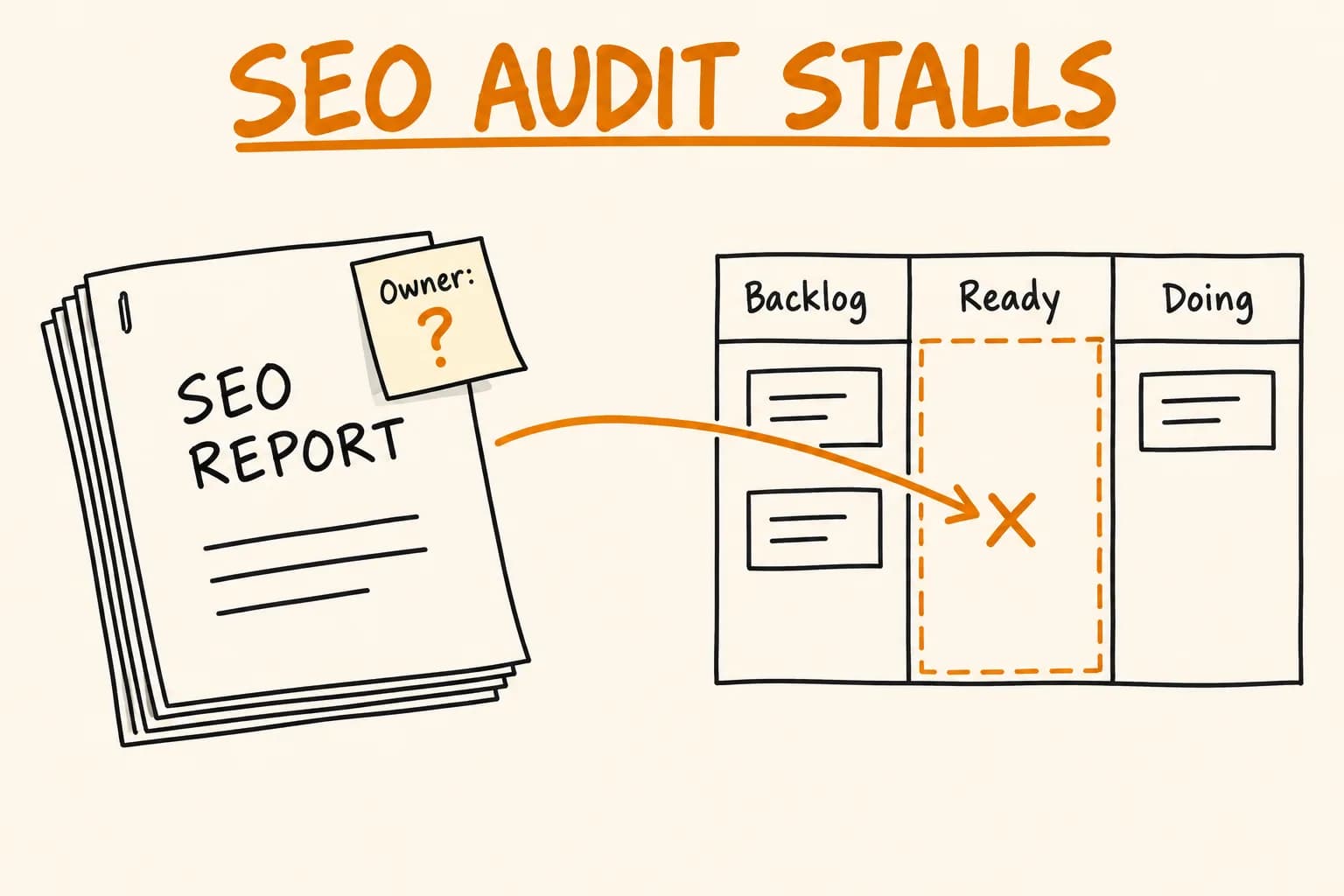
That upkeep is the part that gets dropped, for the same reason reports get dropped: nobody owns it. I wrote about why in the article on SEO reports that never get implemented, and the multilingual version is the same problem multiplied by the number of languages.
My monthly SEO & AI Search Optimization service covers per-market and per-language keyword research, the technical layer including hreflang, per-market expansion for multilingual sites, and content in the languages your markets use, with a written report each month. Languages on one site are within scope. A second domain is quoted separately. The text in each target language needs a reviewer: your own translators, or a translation pipeline whose output your native speakers check. I do not claim fluency in your markets’ languages. The service costs €1,200 a month for the first six months and €800 a month after that, with no minimum term; you can end it at the end of any month and everything built stays yours. First measurable movement usually takes 2–4 months and longer in competitive markets, and I do not promise positions.
Who Should Not Buy This
This is the wrong purchase if:
- You sell in one language in one market. Nothing here applies to you, and the general SEO pages will serve you better.
- You need Google Business Profile or map-pack work for one location. That is local-agency work and I do not do it.
- You want guaranteed rankings. I do not sell that.
- You do not want to publish each language properly. If there is no one to review translations and no intent to maintain the versions, more languages will cost more than they return.
- You have several domains and expect one price. The scope is one site. A second domain is quoted separately.
The Next Step
Take the market you care about most. Check three things: whether its keyword research was done in that language, whether the hreflang set on your site is complete and reciprocal, and who is named as responsible for keeping both current.
If you cannot answer one of those, write to me with the site and the markets, and I will tell you what is missing and whether it needs monthly work or a one-off fix. If the honest answer is that you should stay in fewer languages, I will say that too.