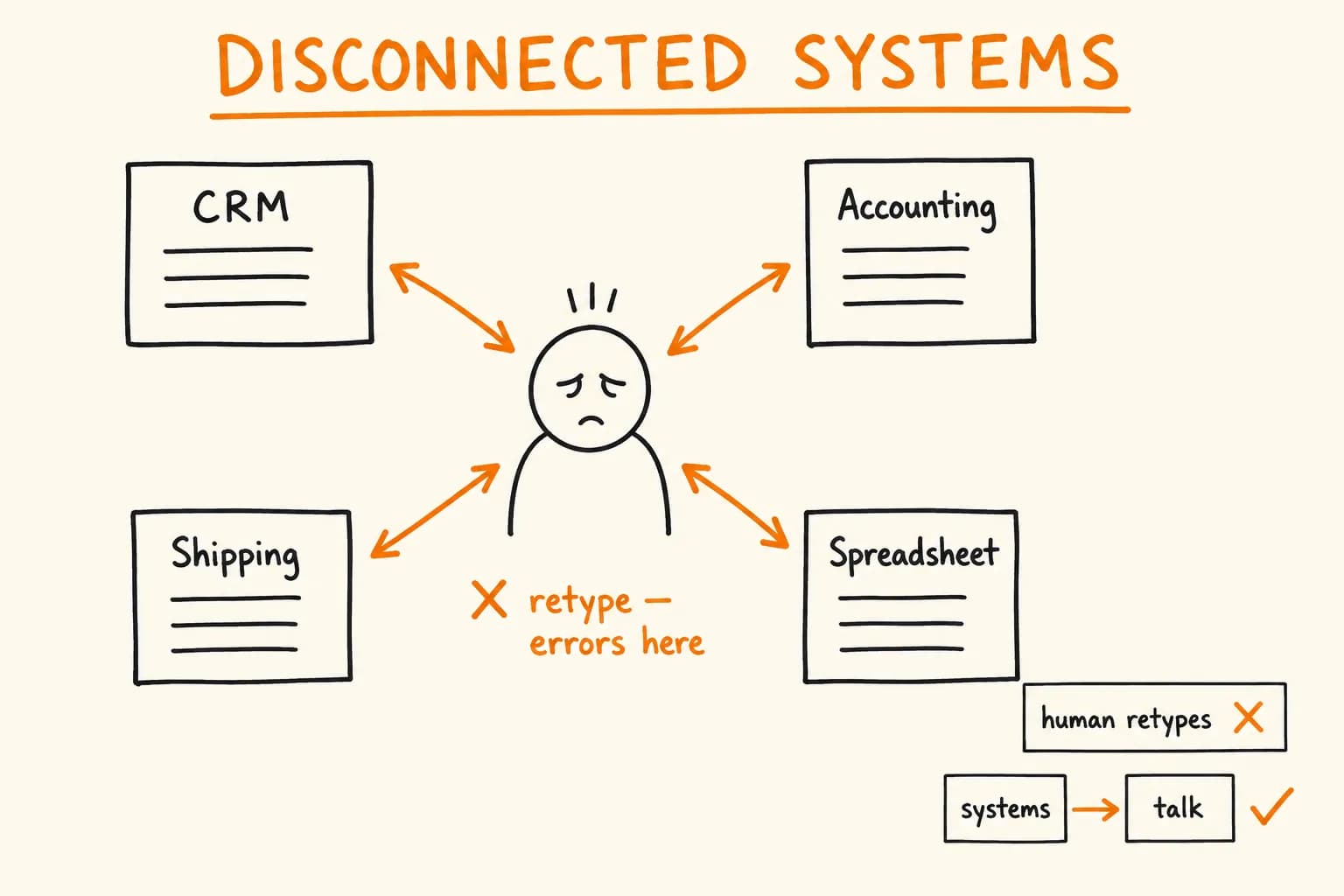
Most businesses don’t buy disconnected systems on purpose. They arrive one tool at a time. You start with a spreadsheet. You add a CRM because the spreadsheet stopped scaling. Accounting software because the taxman insisted. A shipping portal because you started sending parcels. Each choice was sensible on its own day.
Then one morning you look up and realize that none of these tools talk to each other – and the thing holding them together is a person. Someone reads a number off one screen and types it into another. That person is your integration. And that’s a cost you’re paying every day without ever seeing it on an invoice.
The Cost You Don’t Get Billed For
Here’s the trap. The cost of a disconnected system doesn’t show up anywhere you look. It’s not a subscription. It’s not a line item. It’s hidden inside a job title.
Someone on your team spends the first hour of every day taking yesterday’s orders and copying them, one at a time, from the checkout into the accounting system, then into the CRM, then into the shipping portal. It feels like work, because it is. Nobody questions it, because it’s always been done that way.
But watch what actually happens as you grow. At ten orders a day, that copying is an hour. At thirty, it’s most of a morning. At sixty, it’s a full-time role whose entire purpose is retyping data that already exists somewhere else. You never made a decision to create that role. It grew on its own, one order at a time, and now it sets a limit: you can only take as many orders as one person can hand-transcribe before they burn out or start making mistakes.
That’s the real shape of the cost. It isn’t the minutes. It’s the ceiling. When a human is your integration, your growth is capped at the throughput of that human – and you’ll experience the cap not as a cost, but as a vague sense that ‘we can’t handle more right now.’
Where the Errors Live
The second cost is quieter and more expensive: the mistakes.
Anything a person copies by hand between two systems will eventually be copied wrong. Not because they’re careless – because they’re human, and it’s the fiftieth address of the day. A digit drops off a VAT number. A shipping address goes to the old one. A price on the invoice doesn’t match the price in the contract. Each of these is small until it isn’t: an order stuck at a border, a parcel sent to the wrong city, a customer who now trusts you a little less.
I built a shipping automation for a manufacturer where, before the work, every parcel was booked by hand – a staff member copied the name, address and phone from one system into the carrier’s portal, generated a label, and emailed the tracking number back to the customer. Five to seven minutes each, twenty to fifty times a day. The minutes were bad enough. But the real problem was the country codes: the UK arrives written as ‘UK’ in one system and the carrier only accepts ‘GB’. A human catches that most of the time. Most of the time is exactly the problem. Once the systems were connected, that translation happened the same way every time, and shipment errors dropped to a handful of isolated cases a month.
The pattern generalizes. Every seam where a person hand-carries data between two tools is a place errors are born. Connecting the systems doesn’t just save the copying – it removes the entire category of mistake.
What ‘Connected’ Actually Buys You
When systems talk to each other directly, the human stops being the glue. The data moves once, on its own, correctly.
On another project – an international e-commerce build for a manufacturer expanding across Europe – the order workflow used to be six manual steps across four tools: confirm the payment, create the deal in the CRM, log the accounting entry, book the shipment, generate the invoice, email it out. About thirty minutes per order, by hand, every time. Fine at a dozen orders a week. Impossible at the volume a European launch would bring.
The fix wasn’t a better spreadsheet or a faster typist. It was connecting the tools so that the moment a payment cleared, one flow fired: the CRM got the deal, the accounting system got the entry, the shipment got booked, the invoice generated, and the confirmation email landed – with no one touching any of it. Payment to invoice in the customer’s inbox dropped from about thirty minutes to under two.
Notice what that number really unlocks. The thirty-minute saving per order is nice. But the point is that opening a new market stopped requiring more people. A business that used to grow by hiring transcribers could now grow by changing a setting. The ceiling moved from ‘how many orders can one person process’ to ‘how many can the system handle’ – which is a much higher ceiling.
That’s what connecting systems actually buys: not saved minutes, but a removed limit.
When Manual Is Genuinely Fine
Here’s the part most articles on this topic won’t tell you, because they’re usually written by someone selling the integration: not every gap between two tools is worth closing. Sometimes a human copying data by hand is exactly the right answer, and automating it would be a waste of your money.
Leave it manual when:
- It happens rarely. If you move data between two systems twice a month, connecting them is a hobby, not an investment. The build will cost more than a decade of copying ever would. A person and a spreadsheet is the correct tool for genuinely occasional work.
- The judgment is the point. Some steps look like data entry but are actually a person deciding something – whether this order looks fraudulent, whether this customer gets an exception, whether these two records are really the same company. Automating the copying is fine; automating the judgment produces fast, confident mistakes.
- The process is still changing. If you’re not sure the workflow is right yet, don’t cement it in code. You’ll pay to automate a process you abandon in three months. Let it stabilize by hand first, then connect it.
- The volume is flat and low, and it’s staying there. A connection earns its cost by removing a ceiling. If there’s no ceiling – if you’re not trying to grow past what one person can handle – there’s less to gain.
The test is simple. A gap between two systems is worth closing when the copying is frequent, error-prone, and standing between you and more business. If it’s rare, judgment-heavy, or genuinely not blocking anything, leave it alone. Connecting it would be complexity for its own sake, and you’d be paying to maintain a machine that solves a problem you didn’t have.
How to Find Yours
You don’t need an audit to spot the integration you’re missing. You need to answer one question honestly: if your volume doubled next month, whose job would break first?
Whatever you just pictured – some person, some spreadsheet, some end-of-day ritual of moving numbers between screens – that’s where a human is currently doing the work two systems should be doing for each other. It’s usually the thing everyone has quietly accepted as ‘just how it works around here.’ Nobody’s counting the hours, because the hours were never the point. The ceiling was.
If that seam is frequent, error-prone, and capping how much business you can take, connecting the two systems is one of the highest-return things you can do – not because it saves time, but because it takes the limit off. And if the honest answer is ‘actually, that’s fine by hand’ – then you’ve just saved yourself a project. Knowing the difference is most of the value.
If you can name the person who’d drown first when your volume doubles, you’ve already found the two systems that need to start talking. Let’s look at what that gap is costing you.