You’ve decided to build the thing. You send the same brief to three developers, and the quotes come back thousands apart. One is a fraction of the others, and it’s tempting to read that as the same product for less money.
It almost never is.
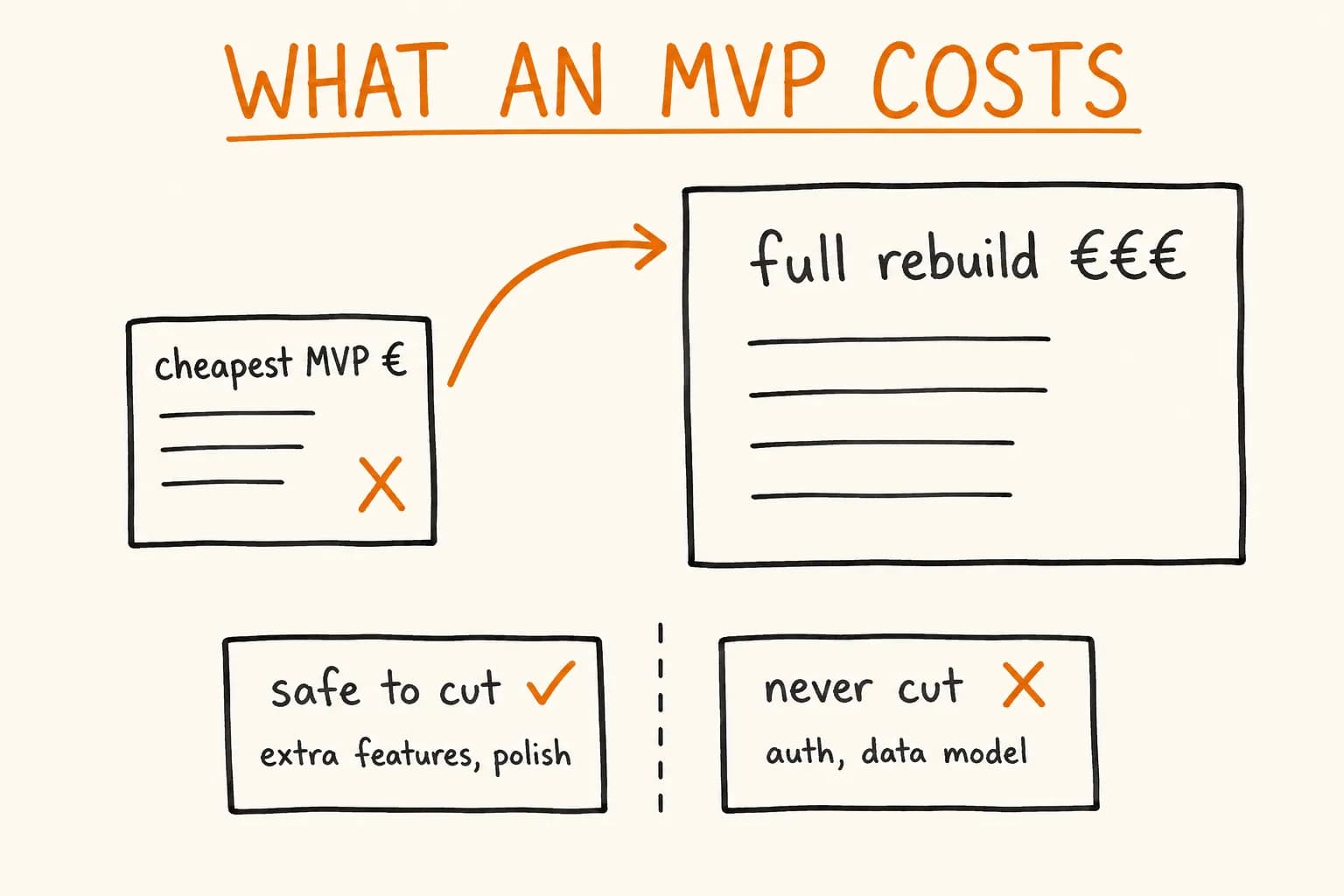
The cheapest quote is rarely the same work done cheaper. It’s a different, smaller amount of work – one that produces something that demos well and falls apart the moment real customers touch it. The gap between the quotes isn’t margin. It’s the corners the cheap one is quietly cutting, and you’re the one who pays to un-cut them later.
So before you pick a number, it’s worth understanding what actually drives the cost of an MVP – and, more importantly, where cutting cost is smart and where it’s a trap.
Where the Cost Actually Comes From
An MVP is not a pile of features priced by the unit. Most of the real cost sits in a few places founders don’t see on the surface.
- Scope. The single biggest driver, and the one most under your control. Every screen, every ‘while we’re at it,’ every integration adds time. This is where a good builder earns their fee – by talking you out of things.
- Data model. How your information is structured underneath. It’s invisible in the demo and expensive to change after launch. Getting it roughly right early is cheap. Getting it wrong is a rebuild.
- Correctness where it matters. Login that can’t be bypassed, payments that charge the right amount, tax handled properly. This is careful, boring work, and it’s a large part of any honest estimate.
- The unglamorous 30%. Error handling, edge cases, the states nobody screenshots. A demo skips all of it. A product that survives contact with customers can’t.
A cheap quote usually gets there by shrinking the last three. The scope looks the same on paper. What’s missing is everything that doesn’t show up in a five-minute walkthrough.
The Cheap MVP That Becomes an Expensive Rebuild
Here’s the pattern I’ve watched play out more than once.
A founder pays for a fast, cheap build. It demos beautifully. The first users arrive. Then the bill for the corners comes due: two customers get charged twice because the payment flow was never made safe against a double-click. The data model can’t represent a customer belonging to two companies, so a whole feature is impossible without restructuring the foundation. Nobody’s logged out properly, so one account can see another’s data.
None of these are visible in the demo. All of them surface in production, in front of real, paying, unhappy customers.
Now you rebuild – except it’s worse than starting fresh, because you’re also migrating live customer data, keeping the broken thing running, and rebuilding trust you already spent. The ‘savings’ from the cheap quote get repaid with interest, plus the revenue you lost while the product was on fire.
The cheapest quote didn’t save money. It moved the cost forward in time and made it larger. That’s the trap.
What’s Safe to Cut
Cutting scope is not the enemy. It’s the whole point of an MVP – the minimum viable is right there in the name. The skill is cutting the right things.
Safe to cut, almost always:
- Nice-to-have features. The admin dashboard, the settings nobody’s asked for yet, the second onboarding flow. If a spreadsheet or a manual step gets you through the first three months, use the spreadsheet.
- Polish that isn’t load-bearing. Animations, a second theme, edge-case screens for situations you haven’t hit yet.
- Scale you don’t have. Building for a million users when you have zero is paying today for a problem you’d be lucky to have.
- Reversible decisions. Anything you can change later without touching the foundation is safe to defer. Ship the plain version, learn, then improve.
Cutting these isn’t cheapness. It’s focus. Every one of them can be added later without tearing anything down – which is exactly what makes them safe.
What You Must Never Cut
Then there’s the short list of things where cutting cost doesn’t save money – it just borrows it at a punishing rate. These are the load-bearing foundations. Skimp here and you don’t get a cheaper MVP; you get a delayed rebuild.
- Authentication and access control. Who can log in, and what each account is allowed to see and do. Get this wrong and one customer sees another’s data – the kind of incident that ends a young product. This is not a feature to bolt on later. It shapes everything above it.
- Payment correctness. If you take money, the amounts must be right, charges must not fire twice, refunds must actually refund, and tax must be handled properly. I once built a whole SaaS billing layer from scratch – mandates, proration, dunning, EU VAT – because payment correctness isn’t optional the moment real money moves. A payment bug isn’t a bug report. It’s a chargeback, a furious customer, and sometimes a legal problem.
- The data model. The structure your information lives in. This is the one thing that’s genuinely hard to change after launch, because by then it’s full of real customer data. You don’t need the final version. You need one that won’t have to be demolished when you add the second obvious feature. A little thought here at the start is the cheapest insurance you’ll ever buy.
Notice what these have in common: they’re all invisible in a demo and ruinously expensive to fix after customers arrive. That’s exactly why a cheap quote is happy to shave them, and exactly why you shouldn’t let it.
How to Read the Quotes
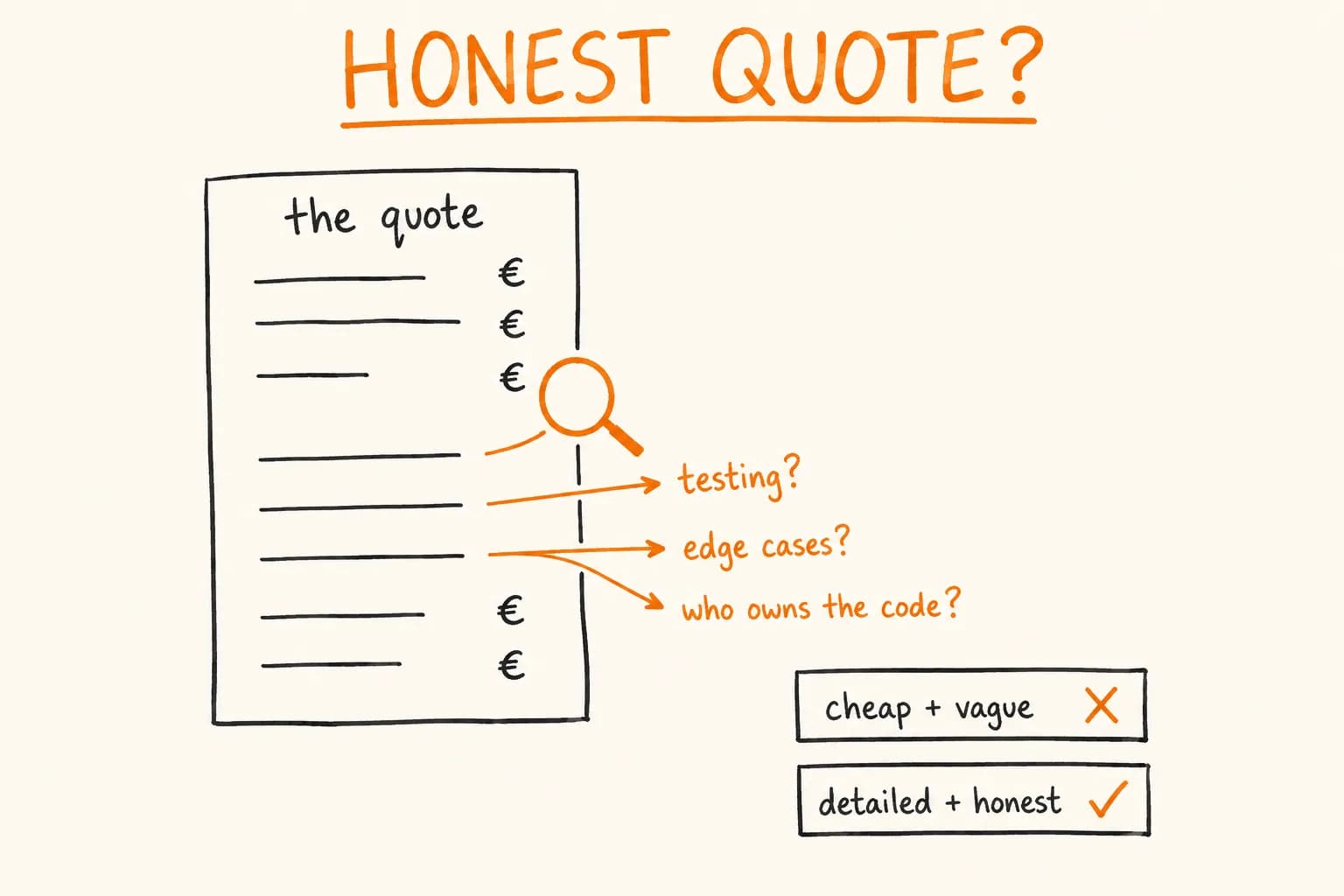
You don’t need to evaluate the code to avoid the trap. You need to ask what the cheap number is leaving out. A few questions do most of the work:
- How are payments made safe against double-charging and failure? A confident, specific answer means they’ve thought about it. A shrug means you’re paying for the fix later.
- What happens when the data model needs to change after launch? You want to hear that it’s been designed to grow, not that ‘we’ll deal with it then.’
- What’s explicitly not in this scope? The best answer is a builder who has already cut things and can tell you exactly what and why. Silence here is the cheap quote hiding its corners.
A quote that’s cheap because it cut nice-to-haves is a good deal. A quote that’s cheap because it cut authentication, payment correctness, or a sane data model is a loan against your future – one you’ll repay as a rebuild, at the worst possible time, in front of your first real customers.
The right MVP spends nothing on what you can add later, and refuses to save money on what you can’t. That’s the line worth paying for.
If you’re staring at two quotes that are thousands apart and can’t tell which corners the cheap one is cutting, that’s a conversation worth having before you sign. Let’s read them together.