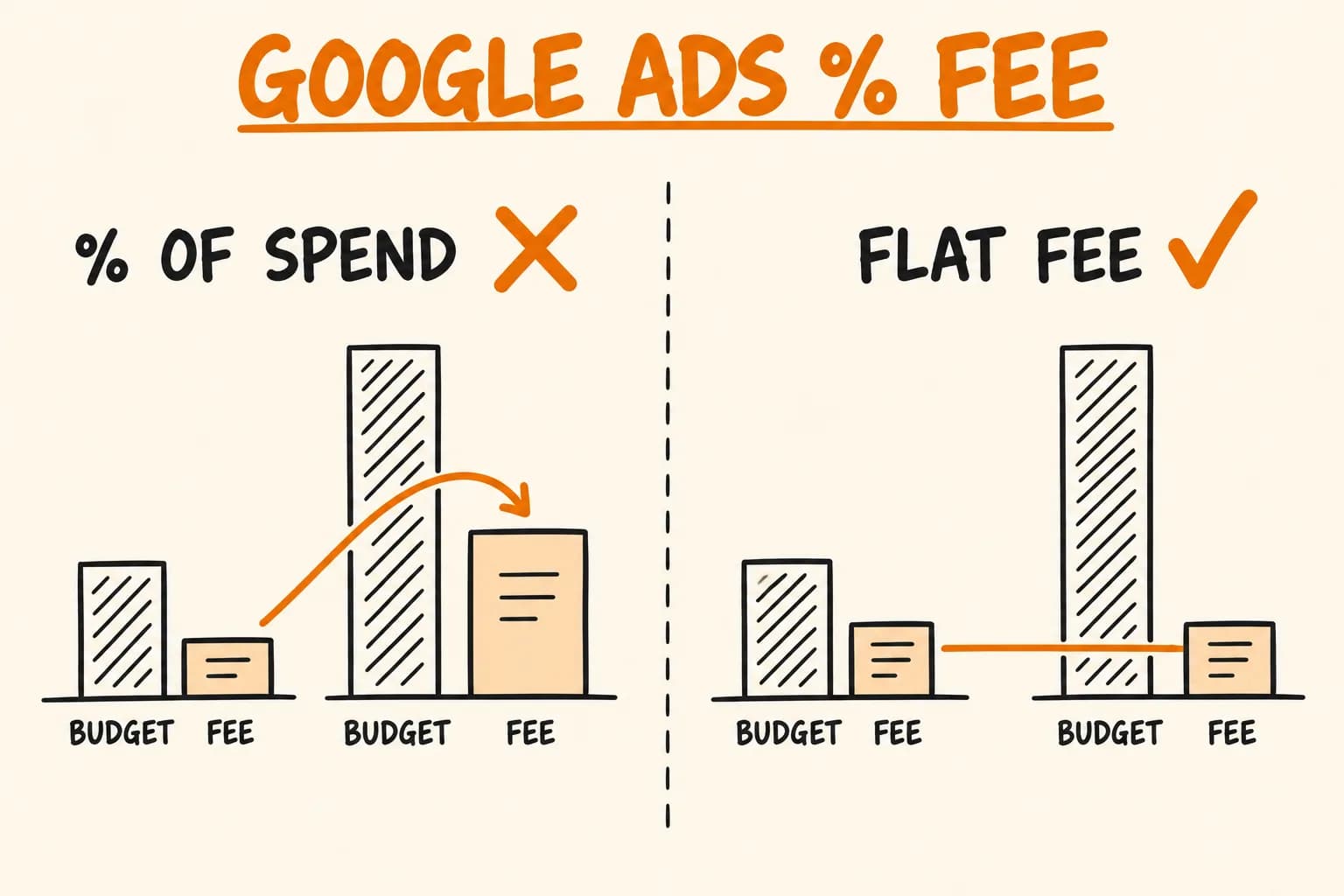
A percentage-of-spend fee pays the manager more when you spend more, whether or not your results improve. That is the whole argument. The rest is when it matters and what to ask so you can tell.
If you are paying for Google Ads management as a share of your ad budget, or you are about to, this is not an accusation against the person on the other side. The point is narrower: the fee structure has a built-in lean, and you are the one who has to know which way it leans.
What a Percentage-of-Spend Fee Actually Pays For
Take a simple case. You spend €5,000 a month on ads and the manager takes a fixed share of that. The next month you spend €10,000. Nothing about the work has to change for the fee to double. Same account, same campaigns, same weekly check-in – twice the invoice.
Now flip it. The manager finds that a third of your budget goes to clicks that never turn into anything, cuts it, and the account performs the same on less money. The fee goes down. They did the most valuable thing in the job, and the structure charged them for it.
That is the mechanism, and it needs no statistic to hold: the fee is tied to the size of the budget, while what you care about is what each result costs you. Those two numbers can move in the same direction. They do not have to.
I am not saying this makes the manager dishonest. Incentives do not decide what a person does. They decide which choices are easy and which ones feel awkward.
Where the Incentive and Your Interest Split
Almost every decision in an ad account has a version that raises spend and a version that lowers it. A percentage fee makes one of them free and the other one costly. A few places where that shows up:
Budget recommendations. ‘We are leaving volume on the table, I would raise the daily budget’ can be true. It is also the one piece of advice that directly raises the adviser’s own income. When the person recommending it is paid on the spend, you cannot tell which reason is doing the work. You can only ask for the evidence behind it.
Reach settings. Settings that widen who sees your ads can be right for a given business. They also raise the amount that can be spent. If the answer to ‘why this setting?’ is a general principle rather than something you can see in your own search terms or placements, ask for the specific case.
Cutting waste. Pausing a campaign, tightening keywords, or turning off a placement that eats money is the dull part of the job. Under a percentage, each of those lowers next month’s fee. It can still get done. It just has to get done by someone whose pay is pointing the other way.
Reporting on the wrong thing. A report built around impressions, clicks and spend looks busy and tells you little about whether the account earns its keep. Spend is the number a percentage fee is calculated on. What matters is what you got for it.
All of these are ‘can’ and ‘tends to’, not ‘does’. I have no sample to back a claim about how often it happens, and I won’t invent one. What I can say is that you are trusting someone with your money in a setup where their income rises when your budget rises. That deserves a few direct questions.
When a Percentage Fee Is Still Reasonable
I do not think a percentage is always wrong, and a flat fee is not free of problems.
A percentage can be reasonable when:
- The spend is large and the work really scales with it. A big account with many campaigns, many markets, constant creative testing and a lot of moving parts takes more time as it grows. A fee that grows with it is not absurd.
- There is a cap or a floor. A percentage with a ceiling, or a percentage that steps down as spend grows, softens the pull. You can see where the incentive stops.
- Part of the fee is tied to a result you both defined. A performance-linked element can work if the result is something you can check independently, and not only something the manager reports.
- The terms are written down and you can read them. Fee base, what counts as ‘spend’, what is included. No surprises on the invoice.
A flat fee has its own weakness. It does not reward growth. If the account is working and the right move is to spend four times as much, a flat-fee manager gets the same money for four times the responsibility, and might be less keen to push for it. A flat fee also fits badly if the scope keeps expanding without anyone resetting the price. You end up with either a manager doing extra work for free or a manager who has quietly stopped.
So the summary is not ‘flat good, percentage bad’. It is: every fee structure leans somewhere. The question is whether you know where, and whether the lean can hurt you.
Questions to Ask Any Provider Before You Sign
These work whatever the fee structure is. They are more useful on a percentage, because the answers show how the lean is handled.
- What exactly is the fee calculated on? Total spend, spend after platform credits, spend across all channels? Is there a minimum, and does it apply even when spend drops?
- Who owns the account? The ad account, the analytics property and the data should be yours, with the provider holding admin access. If you leave, you should not have to rebuild anything or ask permission to see your own history.
- What do you do when spend should go down? Ask for an example, in their own work, of a time they recommended cutting budget or pausing a campaign. A manager who has done it will answer quickly. Ask what that did to their fee.
- Is ad spend paid directly to the platform, or through them? Paying Google from your own card keeps the fee and the budget separate, and lets you see exactly what was spent.
- What counts as a result, and who checked it? If ‘conversions’ means whatever the account says it means, the reports only prove the account agrees with itself. Measurement has to be right before any fee structure matters.
- What will I see every week, and every month? A short written summary of what was spent, what it produced and what was changed is a reasonable ask. A dashboard login alone is not the same thing.
- What happens if I want to stop? Notice period, who holds what, how handover works.
There is nothing hostile in these. A provider with nothing to hide can answer them in a few minutes.
What a Flat Fee Changes, and What It Doesn’t
I run paid ads for Google Ads, Meta and Reddit on a flat fee: €400 per channel per month, no setup fee, and no percentage of spend. An account with one campaign in one market and one language, at a moderate budget, takes about the same weekly attention whether it spends a little more or a little less. So the price follows the scope: how many channels, markets and languages, not how much you put into the ads. A large account with many moving parts does take more work, as noted earlier.
What that changes is the direction of the lean. A recommendation to cut spend costs me nothing, and a recommendation to raise it earns me nothing extra. You can still disagree with my advice, but you do not have to guess whether the advice is paying for itself.
What it does not change:
- It does not guarantee results. I commit to the work and a written monthly report, not to a cost per lead or a return on ad spend. Anyone promising those in advance is guessing.
- It does not remove the weakness above. If an account takes off and needs much more attention, a flat fee does not rise by itself. That is a conversation about scope, and I would rather have it openly than hide it.
- Ad spend stays with you. You pay Google, Meta or Reddit directly, from your own account. The accounts stay yours; I get admin access, not ownership.
What My Own Google Ads Account Taught Me
I should say where I stand on Google Ads for my own offer, because I have run it on my own site.
For about two months I ran search campaigns for my services. Total spend was €203.78, with 247 clicks and 6,686 impressions, and no real inquiry came out of it. I paused all campaigns on 19 June 2026, and they remain paused. It was my account and my decision to stop, and nobody’s fee depended on my continuing.
This is not a success story, and it is not evidence that ads do not work. It is one small account, one offer and one person. My services are bought on trust. At that volume, 247 clicks is simply too few to expect a lead from a product like that. The result is unsurprising, and it fits why I do not sell Google Ads as a guaranteed channel.
It also shaped how I think about the fee question. Small, thin spend on an offer that needs trust to close is a place where no fee structure will rescue the outcome. Some accounts are limited by the offer or the volume, not by who manages them. That is a different problem from the one in this post, and a fee cannot fix it.
Is This Fee Structure Right for You?
A flat fee per channel suits you if:
- You already spend, or plan to spend, enough on ads that the question of who benefits from that spend matters to you.
- You want the accounts in your name, a written report each month, and advice you can test.
- You are fine with a defined scope, and happy to revisit the price if the scope grows.
Paying anyone to manage Google Ads, on any fee, is probably the wrong move if:
- Your budget is tiny. At very small spend, the management fee can exceed what the ads could plausibly return, and a few hours of learning the basics yourself may serve you better.
- You sell something people buy on trust and referral. A high-consideration service with a few leads a year does not always generate enough search demand to learn from.
- You cannot tell a real inquiry from a click. If you have no way to say which leads became customers, no manager can optimise toward that, and no fee structure will help.
If you are weighing a percentage offer against something else, my post on reading a software quote takes a related angle: you judge a seller by how they handle uncertainty and what they are paid for. Read the fee first, then the pitch.